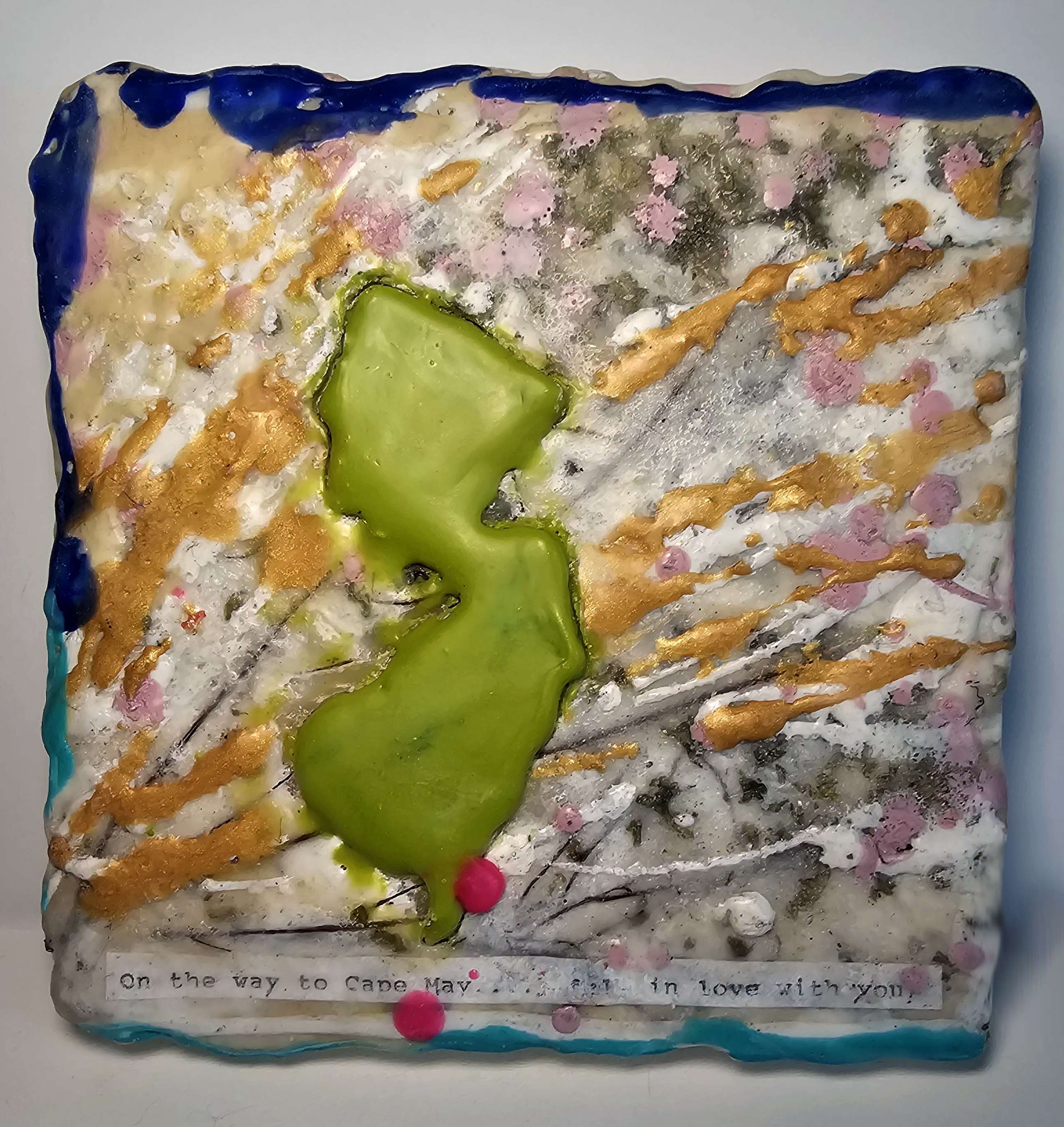
Two Shorelines
Tara Good’s work has always been informed by her surroundings. Early series reflected the landscapes of coastal Savannah, Georgia in misty atmospheres of reflective silicate minerals, and densely collaged, textured surfaces reminiscent of the train cars riddled with graffiti that rumbled past her historic studio in Clyo. This new opus focuses on a different shoreline and it shares many of those early qualities, namely an attention to surface and Regionalism, bringing new imagery and information to the substrates via the exploration of the figure. Long gone are the misty landscapes of Lowcountry fog, replaced by the people and places that make up her current everyday experience among the barrier islands of coastal New Jersey. A strong thread of Formalism can be traced throughout her oeuvre along with a continued interest in technique and media, a topic of research she has been engaged in for some time. Her ability to elevate industrial elements into fine art is prevalent and strives to build connections between communities.
Good is not satisfied to simply point the brush and say Look; rather she desires her viewer to look, see, feel, and adore.
Good is a life-long multidisciplinary maven, including home restoration in the deep South, which is the foundation of her interest in tactile, rich surfaces and industrial processes. Surfaces are like fingerprints, reflecting a life well, or not so well, lived, frozen like insects in amber. To embrace this phenomenon, Good turns her hand to collage (additive) and de-collage (subtractive), layering paints, pigments, minerals, and fragments of materials together, drawing imagery from the texture rather than just juxtaposing imagery upon it.
Working with paint manufacturers and chemists, her colors literally and figuratively glow, giving them a shifting, light-filled vitality. New to her paint supply is the ancient practice of encaustic, which is the use of a wax medium in conjunction with the pigments. Also, Good fabricates her own cold wax by incorporating her materials and mediums onto a variety of surfaces. By experimenting within the guidelines of historic recipes, ensuring what has already been made to last forever, seemingly, has been weathered away. Wax slows the passage of light and leaves a variety of sheen that enhances Good’s pigments and adds a subtle depth to the work.
Many artists work with exclusive pigments, but few delve so deeply into the technical aspects of their media as Good. She maintains contacts with her paint-making partners and tests the limits of their skills. This material understanding merges with her content, leaving us a sense that her painting was not only painted but “built” like a small window in a room we are privileged to peer into.
The figures in Good’s work are real people, not just fictions, whose surroundings inform us of their character. Like one of her artistic heroes, Alice Neel, Good is more interested in the malleable possibilities of her figures to merge with their grounds rather than anatomical accuracy. One portrait in her collection radiates a psychic angst, the arms and legs twisted in front of the body like a bulwark of trees to protect the sitter, which is rendered in sumptuous fleshy paint. It’s a powerful portrait of a complex person and a touching moment amid a collection of brilliant color, seaside denizens, and radiating walls. Good utilizes her sitter as part of a familiar environment and examines many generations by finding the common thread that links us all to the area, abandoning any political affiliations, social status, religious beliefs, so that she can capture a moment in time we can all touch. Cartoon Realism portraits emphasizing Regionalism Good continues to create living paintings and states, “I don’t want to simply capture a one-sided story, but the multifaceted complexity of being human.”